






























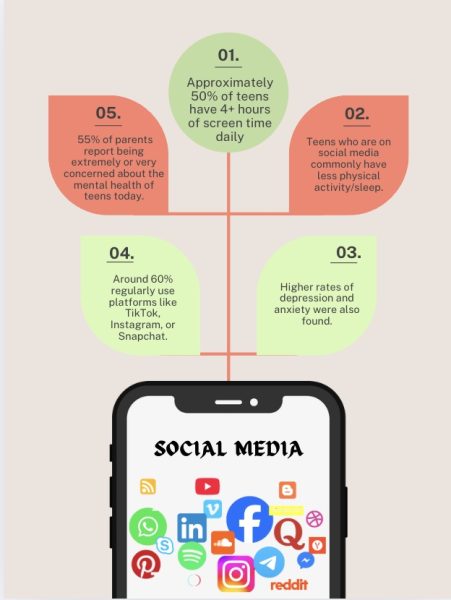
The online world promises connection, knowledge and self-discovery. Yet, for many high school students, endless scrolling through social media has turned into a trap. When students find viral terms, self-diagnoses, or some negatively relatable phrases, they often internalize these labels, seeing them not as temporary struggles but as unchangeable parts of their identity. This negative way of defining themselves can hold back their personal growth, leading students to use information from the internet as an excuse to give up trying, avoid challenges and procrastinate instead of tackling the messy but necessary work of self-improvement.
This effect begins with how much time students spend on screens, which takes over their lives. Kendra Caralis, who teaches AP psychology, has noted how this constant digital presence affects students’ emotional well-being.
“I think being on your phone all the time has been shown… people that suffer from depression also have five or more hours a day on their screen,” Caralis said. “If you’re comparing yourself to the best parts of everyone else, we’re going to try to live up to it. So just being on social media and seeing that all the time, it’s definitely going to affect someone’s mental well-being.”
When students feel they can’t measure up, they may look for validation or reasons for their failures. Social media easily provides these answers through trendy labels or terms that define burnout, anxiety or lack of motivation. While finding a relatable label can feel comforting, students often mistake this sense of validation for progress, causing them to develop a negative mindset. This mindset becomes a barrier, forcing students to retreat from new activities and goals that don’t align with their chosen label. Caroline Ward ’26, an AP psychology student, recognizes that this barrier has real, limiting effects on personal ambitions.
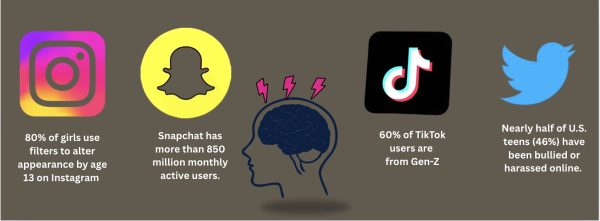
“I feel like I got stuck with that for a very long time,” Ward said. “I used to say ‘I’m not athletic.’ And it would hold me back quite a bit, because I would believe I’m not athletic, so I can’t. And as soon as I said ‘I can’t’, it took a really long time to improve because of that.”
It’s easier to blame a tough task on something unchangeable instead of facing the fear of failure or putting in the effort. For many, seeing perfect success stories online changes how they view success, making their own lives feel incomparable, which can kill their drive. Chloe Craig ’26, a student in AP psychology, saw how little these online labels really matter.
“I definitely find myself comparing myself to some other people,” Craig said. “And that definitely affects how I think of myself and what I think I’m able to do.”
This harmful cycle of comparing herself made Craig start to question the purpose of the emotional content she was seeing online. She quickly understood that the trend of self-labeling offered some comfort, but it didn’t help her move forward.
“I think social media is more for helping you feel understood,” Craig said. “I think that it’s kind of hard to find someone who encourages real change online…Your mental health is your own battle. And I think that’s something that somebody can guide you through, but it’s not something that somebody can promote change.”
The impact social media has on Gen-Z’s mental health is not just in people’s heads. Lynn Walsh, a licensed psychologist who works with a few members of the generation, has noticed that this group’s personal views have been negatively affected by their lifelong access to screens and connections with other people online, and how they perceive themselves.
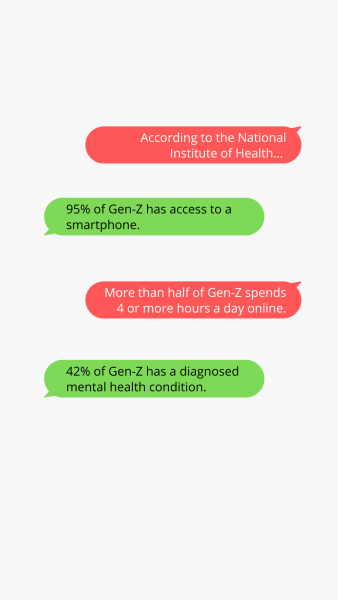 “You have a reflection from what might seem like the objectively true world, and you’re comparing yourself to these things that are not objectively true,” Walsh said. “Gen-Z compares themselves to something that is impossible, and so therefore judges themselves more negatively.”
Advisors at South feel similarly to Walsh, too. Counselor Nicholas Bernbeck acknowledges that consistent online exposure in this generation is a big contributor to anxiety and stressful thought processes.
“When you have all this visibility, and the ability to see what other people are doing, and you know other people can see what you’re doing… there’s this idea that you have to be perfect,” Bernbeck said.
Another effect, especially locally, that Walsh has noticed on the minds of students, is the expectations put on them by their parents and real-life peers. She believes that even the town South students reside in can hurt their self-image.
“Growing up in Grosse Pointe doesn’t help because you grow up in a very competitive environment, where so and so’s dad went to Stanford,” Walsh said. “You’re gonna have a lot of expectations, so you’re going to tend to be more hard on yourself.”
Walsh, as someone who has seen this trend more in her career, has some solutions to offer. Even if they sound unpleasant to most, they can help those who wish to get out of negative trains of thought.
“The first step would be to vastly limit your time on social media, or if you don’t want to do that… set up your TikTok, your Instagram, your Snapchat, to where people can’t leave comments,” Walsh said. “You don’t want to reinforce the dopamine hit you’re getting when someone makes a comment.”
While Walsh suggests that we should create digital boundaries, many students found the best way to deal with online pressure was to swap out screen time for real-life activities.
“I would definitely say being around animals in general makes me feel a lot more calm. And choosing the right people to hang out with feels like it’s part of what built my confidence,” Craig said. “I feel comfortable around my horse and at the barn, and definitely my friends as well. Like surrounding myself with the correct people.”
This need for an immersive, device-free activity is a therapeutic strategy shared by teachers. Caralis has her own methods for real-world dissociation from what brings her down and rejuvenates her mind and thoughts.
“Playing sports is probably the one place where I feel most like everything goes away,” Caralis said. “It’s an hour in my life where I’m not thinking about anything else going on in my life. And I love it. It’s so it really does bring me back down to liking what I enjoy.”
Bernbeck agrees with the idea of using more real-life strategies to cope. He encourages students to participate in a calming, familiar activity that can help them reduce negative feelings about social stress.
“Self-care things are always a good idea. You can do breathing exercises, and I like it to be something active too,” Bernbeck said. “You’re going for a walk, or reading a book, or listening to your favorite record, all of those things that you’re an active participant in.”
Ultimately, whether it’s through pursuing a sport or learning to step away, escaping the negative effects of social media means replacing the comfort of a label with the dedication to personal effort. This commitment is best maintained when students have support to guide them through the messy reality of growth, which is usually much less polished than what you see online. This need for genuine, non-judgmental connection is the final step in breaking the vicious cycle.
“Find someone you can talk to. Whoever it is, find someone,” Caralis said. “And I think that goes above a friend, because friends are great, but it’s heavy and it’s a lot to deal with. So find an adult that you can talk to, whoever that is, that you can trust.”