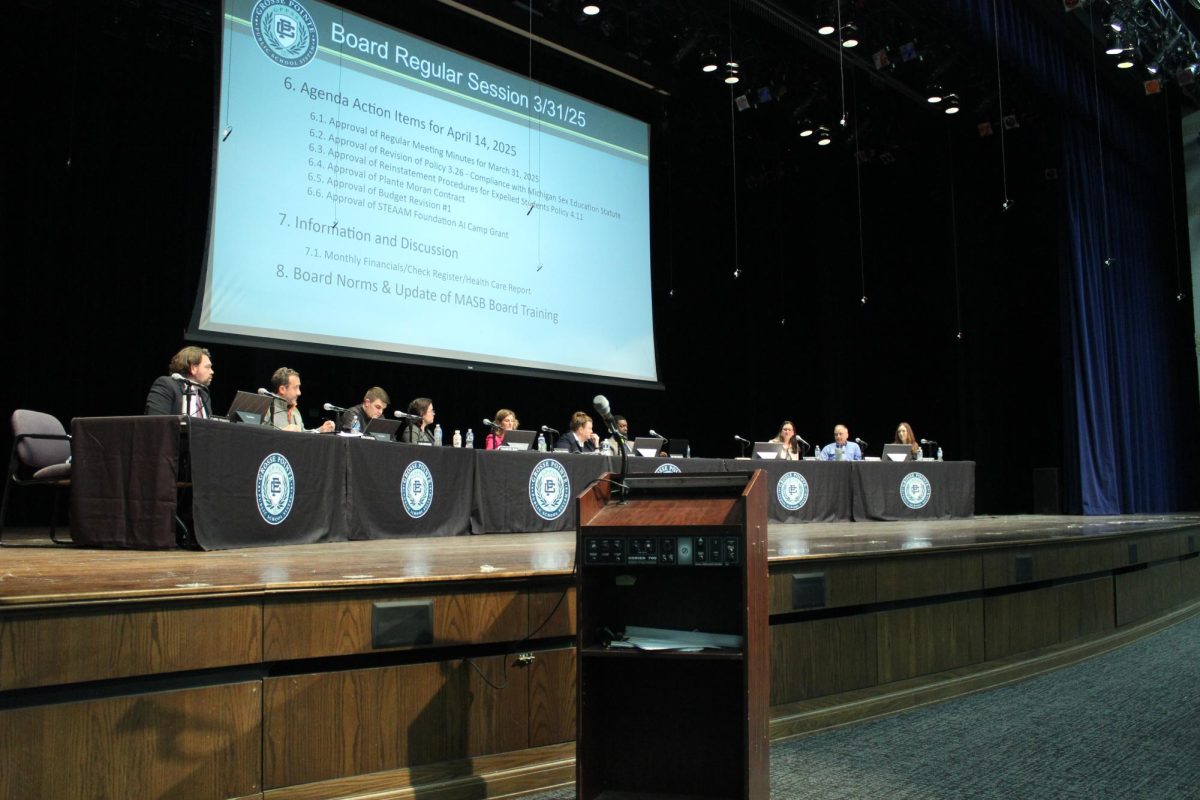























On Feb. 23, the Grosse Pointe Board of Education (BOE) voted to pass a new resolution to formally oppose a series of new bills that would expand the Michigan Schools of Choice program throughout the state. If passed, House Bill 310 would allow Michigan students to attend public schools outside their residential school district without paying tuition. The bill passed in a unanimous 7-0 vote.
“The GPPSS Board of Education believes that decisions about accepting nonresident students are best made at the local level, with input from parents, staff and community members, rather than mandated uniformly across more than 800 diverse Michigan school districts,” the BOE wrote in the resolution.
In the further description of the resolution, the BOE “urges” three points for Michigan lawmakers to consider:
1. “Preserve local-control provisions in current law that allow elected boards to determine participation in Schools of Choice.”
The board’s first request focuses on continuing the system that allows local decision-making regarding involvement in the Schools of Choice program, which has been in place for GPPSS since the program was passed in 1996 and would end with the passing of Bill 5310.
2. “Commission a comprehensive impact analysis, with district-level modeling, before considering any legislation that would mandate open enrollment statewide.”
The board states their concern with the negative impact on unique districts such as Grosse Pointe, districts that are “fully built-out and land-locked,” as the resolution describes.
3. “Meaningfully consult with local boards of education, administrators and community stakeholders prior to advancing any further changes to Michigan’s enrollment statutes.”
The final request stresses the importance of district-to-district personalization when enforcing the bill, taking voices into account from across the state before moving on with the bill.
BOE Trustee Sean Cotton, among the many Grosse Pointe residents who traveled to the Michigan State Capitol to protest Bill 5310, spoke out against the legislation at the Feb. 4 committee hearing.