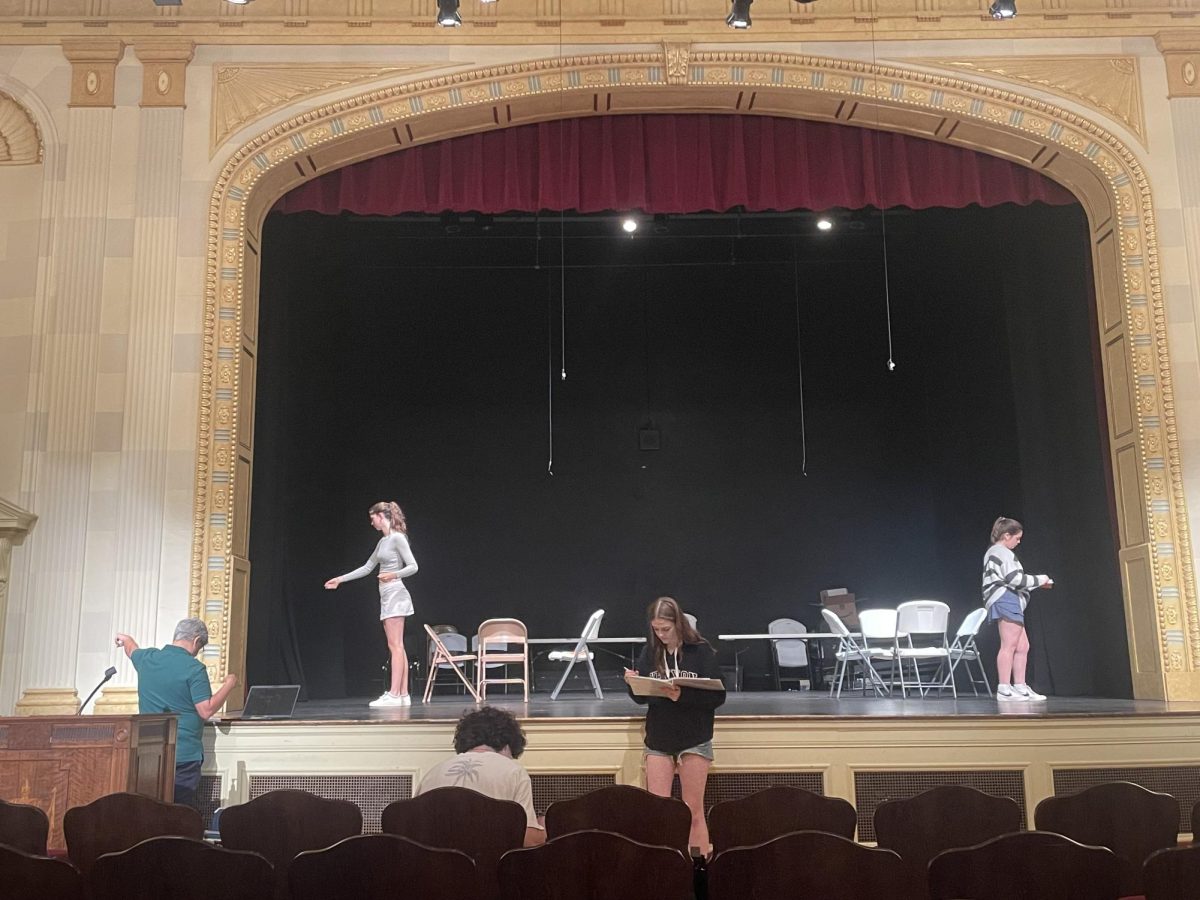





























In 2024, I excitedly went to see the Pointe Players put on a performance of “Our Town” as the fall play for that year. By the curtains’ close, the play’s dark, existential themes of mortality sent myself silently reflecting upon my life on the drive home. Consequently, I walked into the Friday-night showing of this year’s fall play, an adaptation of feminist writer Jane Austen’s “Sense and Sensibility,” not making any assumptions. Upon leaving the auditorium, I was struggling to form an opinion on the dramatic whirlwind I had just witnessed.
Directed by South English teacher Dan DeMarco, the show is set in late-18th century England, following sisters Elinor and Marianne Dashwood – played by Ellie Sahutske and Violet King, both ’26, respectively. The story focuses on the sisters navigating their dramatic lives dealing with the British social hierarchy after they lose their fortune following their father’s untimely death. The comedy features romance and social commentary, with reputation, marriage and women’s social confinement being frequently featured throughout the two-hour runtime.
Some of the heaviest themes of Austen’s writing deals with the comparison of romanticism with realism, represented in “Sense and Sensibility” by the sibling relationship between Elinor and Marianne. Evidently, the play’s execution relies deeply on the believability of their characters, which was one of the greatest strengths of the night. The casting of Sahutske and King as their respective roles was flawless; the two working off of each other’s energy was the only thing more impressive than their performances themselves.
Other notable performances include Zach Neme ’26 as the scandalous, occasionally drunk Willoughby and Leo Neds-Fox ’26 with a hilarious, patient, well-timed depiction of both love interest Edward Ferrars and his comedically-similar-looking brother Robert. Brady Barbour ’26 also stands out to say the least, providing a sporadic and frankly insane display of energy and emotion as the wealthy elite John Middleton. Barbour embodied exactly what the play was: sporadic.
The cast was fully engaged in the lore of the world Austen created, and it showed. However, the entire play was done in British accents, which can be notoriously difficult for Americans to master in a short period of time. As a result, a few direct details of each scene were obscured in the accents, causing a disconnect between the audience and the stage involving specific narrative details.
Accents and zaniness aside, the narrative exploration of wealth and society from the perspective of someone who lived during those times shows a valuable side of issues that are still relevant today. Whether or not a majority of the audience understood those messages is up in the air, but nonetheless, I am now confident to say that while it was a stark change in direction from “Our Town,” the Pointe Players’ tone-switch proved itself a worthwhile decision.