

























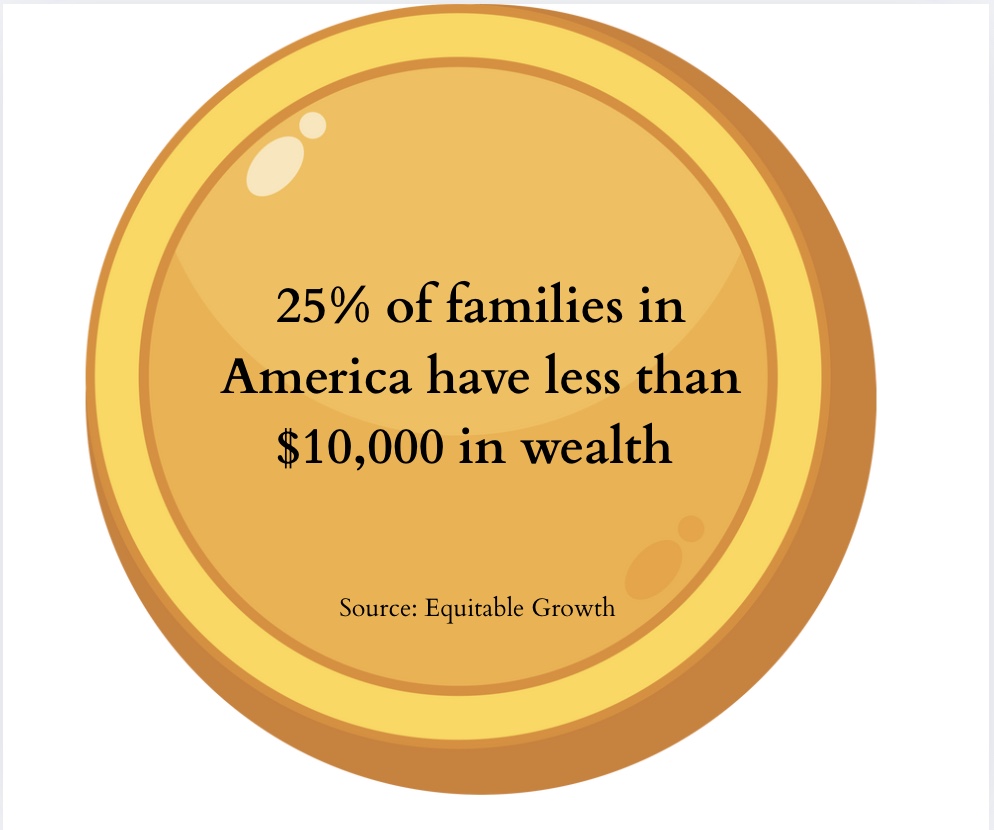
When a highly anticipated concert tour is announced, the excitement lasts only until the ticket prices start to load. For many, the moment when a single seat at a concert costs more than a month’s rent is a sharp, personal reminder of an economic reality. Inflation has recently surged, according to an article in The Guardian. This crisis is making goods less affordable, but the crisis itself runs deeper than rising costs. The cultural experiences that define our generation, from sold-out stadiums to designer stores like Lululemon, are increasingly out of our reach. These high prices allow the upper classes to luxury, leaving the estimated 30 percent of American citizens who are lower class struggling to afford even basic needs, according to Pew Research Center.
This crisis is not random; instead, it is a direct result of decades of policies prioritizing investor wealth over worker wages, creating an economic divide that is, according to AP Government and Politics teacher Andrew Taylor, far more severe than most realize.
“We’ll say that the income inequality now in 2025 is worse than it was at the time of the French Revolution,” Taylor said. “The poor are more poor today than they were during the French Revolution time. The rich are richer and the gap is further.”
The consequence of this historic, unyielding economic imbalance is a market that openly exploits scarcity. Since the corporate system is built to reward the wealthy, businesses are empowered to set prices based purely on what the highest earners can afford. In fact, according to a report by Groundwork Collaborative, corporate profits accounted for 53% of inflation during the second and third quarters of last year, a number far higher than the historical average. This strategy forces prices upward, leading to the concept of cultural inflation. This imbalance of power is often supported by market structures like monopolies, where a single company’s control over a good or service allows them to raise prices at will. Economics teacher Christopher Booth speaks out on what the government can do for rising inflation.
“The government can break up [monopolies],” Booth said. “And then you can have four or five different venues for people to purchase.”
Monopolies have been a major issue since the industrial boom of the 1800s. Today, companies like Live Nation’s Ticketmaster operate as a monopoly in the entertainment industry, allowing them to raise prices at will. This furthers the divide, with the rich getting richer and the poor getting poorer as only the rich would be able to experience the product or service.
“In the airline industry, there’s not a lot of choices right now; the lowest cost airline, Spirit, is going through bankruptcy,” Booth said. “There’s choices you can make with flights, but they’re not really low costs. There’s monopolies and price fixing going on everywhere.”
Prices are not only rising in monopolies but in everyday life, putting pressure on local businesses. Jennifer Bierkle, the owner of High Pointe, a local Grosse Pointe burger joint, gets her ingredients from other local businesses. Beef, the main ingredient for High Pointe’s fa
mous “Smash Burger”, is priced by the ounce, making it vulnerable to inflation.
“What has become a problem is rising food costs,” Bierkle said. “We had to do a slight menu increase a few months back, and already our beef has increased again. We try to price it out so we have room for these price increases, so it won’t affect our profits too drastically.”
Bierkle’s struggle shows the pressure between the need to survive as a business and the desire to serve a community. The daily increase in prices shifts consumer habits immediately, especially for local high school students who rely on places like High Pointe for quick lunches or after-school gatherings. What was once an easy, affordable stop for a smash burger and fries now requires conscious consideration. Zach Neme ’26 recognizes the flaw in the economic models he learns in classes like AP Macroeconomics.
“It’s kind of interesting, because we’re taught this ideal model of economics that everyone is satisfied with,” Neme said. “And then looking at the real world, especially the United States, that’s not what it feels [like].”
This disappointment converts directly into a draining reality where participation in fun activities becomes a series of financial calculations. The affordability gap doesn’t just block access to concerts; it creeps into everyday social life, forcing Neme and others to constantly evaluate the worth of their purchases, creating a culture where not everyone can afford to participate. This disconnect is more apparent when creators preach inclusivity while charging prices that only the elite can afford. Talia Patterson ’26 feels this conflict directly when brands or popular artists maintain luxury pricing.
“So I feel like when stuff talks about being inclusive, they kind of stick to that,” Patterson said. “If you do have to raise your prices to inflation, and it becomes unattainable for some consumers, then you’re kind of being put in a place that makes you look like a liar.”
The true measure of this divide may not be found in economics textbooks or ticket sales, but in the political and social chaos that results when the majority of the population feels permanently excluded. The affordability crisis is chipping away at the foundation of a shared culture, creating parallel societies: one that consumes and participates, and one that watches from the sidelines. This exclusion leads to deep cynicism about the established system.
“I think what you’re seeing now, politically, is more and more people deciding, I’m not going to play the game,” Taylor concluded. “They’re not going to participate in politics, and I think that’s what this leads to, greater division.”
The high cost of participation has a price tag. However, not everyone is willing to accept this. Rather than giving in to the affordability crisis, some students examine the issue. Monopolies and cultural inflation leads to the final question: what happens now? Their answer is not driven in fear, but in using their understanding of economics to examine the affordability crisis and find solutions at its root.
“But the thing is that we figured out the problem,” Neme said. “We know why the prices are going up, and there’s still time to fix the economy so we can include everyone.”