




























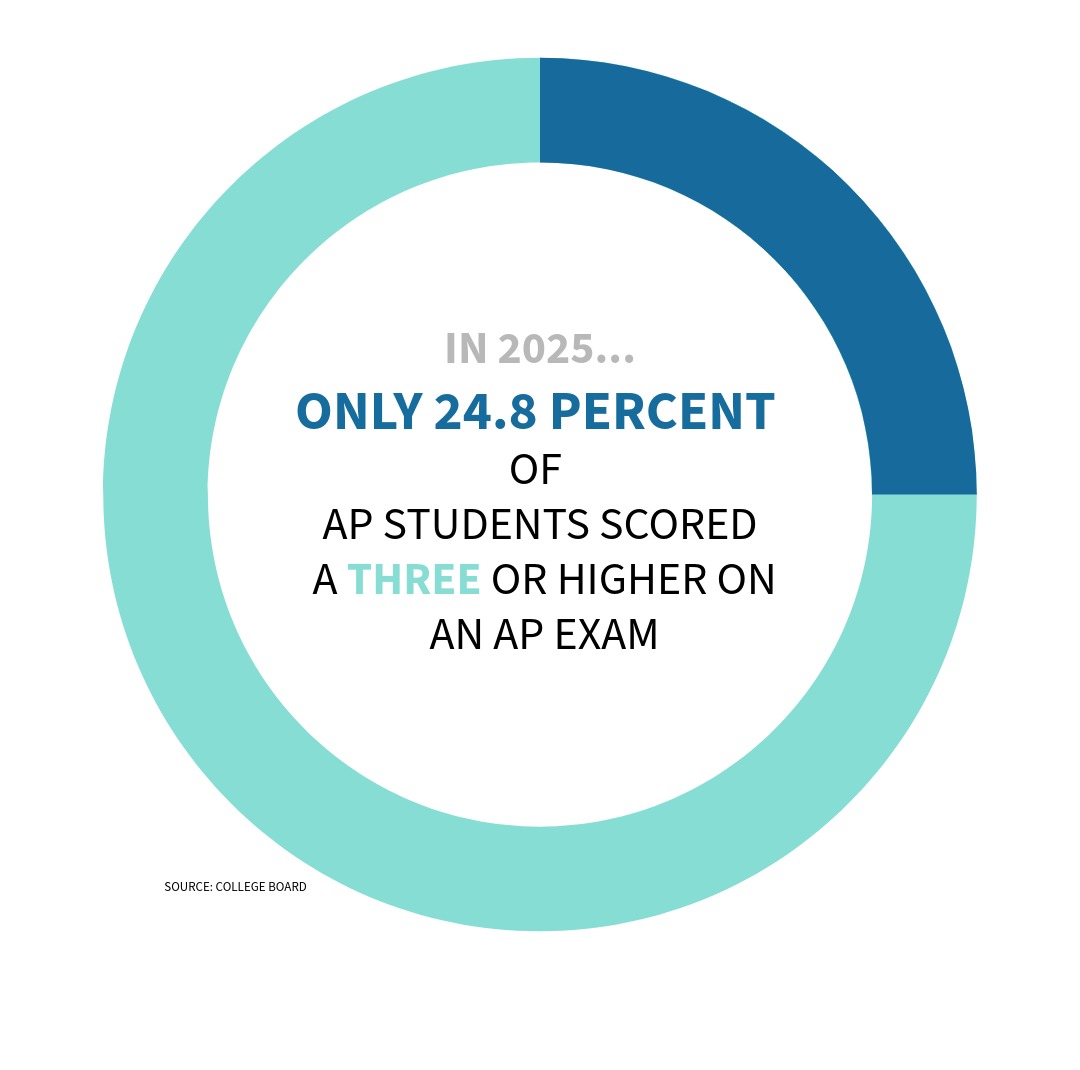
From where I stand, lectures are dreaded by anyone who has ever taken an Advanced Placement (AP) course. The constant cycle of “lecture, notes, test and repeat” is an outdated and inefficient way to learn. It lacks engagement, comprehension and any sense of enjoyable learning. The reason teachers give for this is that it is necessary to learn everything in time for the AP exam by May. And while that may be true, the tunnel-focus vision on one single test takes away from a year’s worth of learning.
AP courses are designed to challenge higher-achieving students with a more conceptual class. In a study conducted by the American Research Journal, the conclusion drawn was that the fast-paced and memorization-based methods that have been implemented in teaching make AP courses counterproductive. As the class borders on too fast to keep up with, actual understanding is pushed aside completely to keep the focus solely on one single test.
As more and more research is done on how we learn, it continues to come out that the best way to have a real understanding of what is learned in a classroom is active learning. The Australian Education Research Organization concluded that students cannot retain too much information at once, which is exactly what AP teachers expect them to do. Active learning, such as hands-on activities, is much more effective in learning, especially among high schoolers. Not only is it extremely hard for most students to focus for long periods of time, but even more so on material they are not always interested in.
Indegene, an online medical healthcare research company, found that within a week, 90 percent of “memorized” facts are forgotten; that’s why they are sometimes referred to as inflexible knowledge. So while you may know that World War II began on Sept. 1, 1939, the understanding of why is not always still there.
Yes, AP classes are indeed meant to be more rigorous and challenging, but the original purpose for that was to be in the complex understanding of the topic, not just inflexible knowledge, something you know but can’t apply. It is unrealistic to rush through extremely intricate topics and connections just so you can skim the surface of as many units as possible.
So, for AP classes to achieve their goals of being a challenging class for deeper understanding, memorization can not be the main focus. Active and engaging learning activities can keep the class as hard as it should be and as productive as it should be. You will never get any long-term gain from a class strictly focused on memorizing as much as possible for one test.
By lengthening the time spent on important topics, students will leave that class with more than just a credit.