































In March 1995, Jake Howlett, ’95, unknowingly had his entire life changed. That month, his classmate, Mary, asked him to the Sadie Hawkins dance at South.
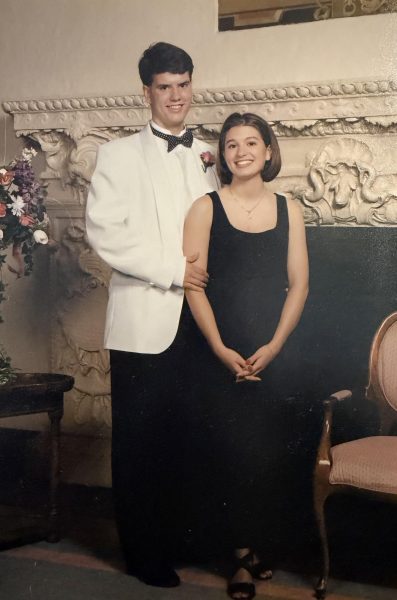
The dance where the girls asked the guys, became Howlett’s first official date with his now wife. While the pair have now been married for 31 years, at the time, Howlett never expected the relationship to turn into a lifelong partnership. Like many teenagers, he simply thought she was a really cool person.
“Dating meant to me, finding a person you liked, that you enjoyed spending time with and that you had fun with,” Howlett said. “And that was kind of about as serious as I took it, at first. It wasn’t until a decent amount of time progressed that you started to look at some of the more serious compatibility type issues and start to think of those next steps.”
The question that often surrounds high school relationships asks how seriously they should be treated. While Howlett’s high school love story ended in a decades-long marriage, the Journal of Adolescent Research found that this high school relationship is among only 2 percent that make it to marriage. Another South alum, Patty Groezinger ’74, sees the more serious outcomes as rarities, and something to consider when dating in high school.
“I don’t think they should be treated seriously at all. It’s still such a growth time for kids that you can’t make a lifelong decision when you’re a teenager, or you probably shouldn’t,” Groezinger said. “Now, did some people do that and it worked? Yeah. But, I don’t think you should. There’s so much to experience.”
Reflecting on her time at South in the 70s, Groezinger sees her high school relationships as casual parts of the experience rather than permanent commitments.
“I still have some friends [from high school] that are still really close… and we look back and we just laugh at our behavior and the guys we dated and why we thought they were cool and maybe we should have dated smarter guys,” Groezinger said. “But we did. We laughed, we were really like, what did you see in that guy? It goes back to the original question: Should a relationship in your teen years be taken seriously? Absolutely not. You know, so much can change.”
Despite this, for some high school couples, it really does work, and that Howlett said, is exactly what happened to him.“When we first started dating, it was not my expectation that we would get married and be together for 31 years so far. But I’m glad I had an open mind about that,” Howlett said. “I’m glad that his things progressed and we sort of fell more deeply in love, that we were both open to that possibility. So I think it depends on the situation of the couple.”
Although the seriousness of high school relationships remains debated, the way they function has undeniably shifted, particularly with the rise of cell phones and evolving technology. Lisa Khoury, South’s school psychologist, has watched that transformation firsthand.
“I feel like you’re always connected and there is no time where you’re truly not connected,” Khoury said. “I mean, some people have their phones on all night together, and some people are texting constantly.” This introduction of cellphones and with it the transformation towards constant communication has created a high school dating experience that is much different than the one Khoury remembers. “Back in the day when there weren’t any [cell]phones, you had to call on a telephone in a common area, in the kitchen,” Khoury said. “And brothers and sisters could hear and mothers and fathers could hear and it was embarrassing.”
With advancing technology, couples can now communicate constantly and privately, even when they are not physically together. Howlett said that change affects the development of relationships and the way couples interact.
“It was less easy to communicate and there wasn’t social media, I think the key was to actually spend time together, probably more so, I would imagine, maybe more so than happens today,” Howlett said.
While some may see modern technology as a setback for relationships that limits real communication, for Turner, whose boyfriend has graduated and is now at college, it has been a tool through their long-distance relationship.
“It’s just a lot of trying to make time for each other. I mean we FaceTime all the time, like every single night,” Turner said. We just try to be understanding because we know we can’t see each other face to face.” As communication methods have changed, so has the prevalence of teenage dating itself. According to the Survey Center on American Life, 56% of Generation Z reported having a boyfriend or girlfriend as a teen, compared to 78% of Baby Boomers.
“It isn’t as important now to be in a relationship, to have a boyfriend, than it was then, not just even a boyfriend, you know, any sort of partner,” Groezinger said. “I think it’s more casual now, I mean, just thinking about my kids too, they didn’t have serious relationships.” This downward trend in the number of high school relationships poses a stark contrast to Groezinger’s own experience while in high school.
“It wasn’t as important [for my children] to be in a relationship, you know, you could go to dances with a group of friends, you could go to parties with a group of friends. That changed significantly. Like dances back when I was growing up in high school, you had to have a date. You had to go with somebody. And some even house parties were like that,” Groezinger said. “So they were able to experience homecoming and proms and things like that, where you know 25 years prior to them being in high school, you would have had to have had a date to go.”
Where teens once primarily relied on meeting people through classes and mutual friends, social media apps such as Snapchat now play a major role in how relationships begin, including for Ben Copus ’28.
“[Snapchat] is how [my girlfriend] Natalie and I started talking, but I feel like you have got to pivot away from it.” From his experience, relationships that remain mostly online can lead to misunderstandings and conflict, leading to stress on both sides.
“I don’t think it’s the same because with a text, there’s so much you can misinterpret. There’s no emotion that you can really put into your writing, which is so much different than talking on the phone or even just seeing someone in person,” Copus said. “So it’s a lot easier to almost get upset with each other if you’re just purely texting because there’s so much that can be misinterpreted.”
Despite criticisms of online communication, social media remains a major way teens initiate relationships. Samantha Turner ’26 had known her boyfriend since childhood, but did not begin talking to him until her junior year through Snapchat.
“I think there’s more talking to people for a short time and not really having that meaningful connection,” Turner said. “But I feel like, because of the day we live in, the age that we live in. Now it’s easier to have that conversation, have that connection for longer because of social media.”
In addition to affecting communication, Copus believes that new technologies and social media influence much more in modern relationships. “I feel like technology and stuff has set almost an expectation to what you’re supposed to aim for,” Copus said. “Sometimes, it’s not reachable.” Beyond the challenges of technology, high school relationships also force teens to balance their closeness with their partner while maintaining independence through their formative years.

“A lot of times it doesn’t go the best because you’re learning how to be your own person and when you’re as close to someone like your girlfriend, it’s challenging to learn how to be your own person because you become dependent on just needing them for certain things,” Copus said. “You become too dependent on the person and you lose your sense of self almost.”
High school relationships happen at a critical time in a teen’s personal development, and Khoury recognizes how this often causes a struggle for balance between growing a relationship while growing yourself.
“I think that’s really important because it provides you as a person, time to grow as an individual and if you aren’t a whole person, then you can’t be a good partner, or a healthy partner, or a responsible partner,” Khoury said. “If you’re not happy, then you can’t love somebody else in a healthy way. I think that’s the bottom line.”
Despite the challenges and cultural shifts surrounding modern teenage relationships, Groezinger believes some of the changes have ultimately been positive.
“It’s refreshing for me to know that you can go with friends, you can be with the same sex partner,” Groezinger said. “All those things are now far more acceptable and it makes good relationships for everybody.”
While relationships may not look the same as they did when Howlett walked the halls of South, the fundamental rules he recommends for a good one remain unchanged.
“Treat each other well, treat each other with respect, but maintain your own life as well,” Howlett said. “It’s important to stay focused on school, your activities, your athletics, whatever the case might be. And it sounds corny and it’s very much a cliche, but if it’s meant to be, it’s meant to be.”