

































There is no sugarcoating it. In the 2020s, the United States recorded over 30,000 gun deaths annually, according to the World Population Review — enough to wipe out every resident of Grosse Pointe Park, Farms, City and Shores in a single year. In 2023, gun violence reached a new high, with more than 45,000 gun deaths, a number large enough to erase the Woods as well. Statistics often feel like white noise until they hit home.
Nobody argues that gun violence is acceptable; the impasse lies in the how. After thousands of hours of research, heated political campaigns and billions of dollars in advocacy, a true sense of safety feels further away than ever. But it isn’t just one issue. We at The Tower feel that what’s stopping us from lowering gun violence in America isn’t a lack of passion, but rather our lack of realistic and direct steps to help bring peace to our nation. It seems that society is often paralyzed by a search for a single “perfect” solution, when we should rather be taking every step available to us.
The main obstacles
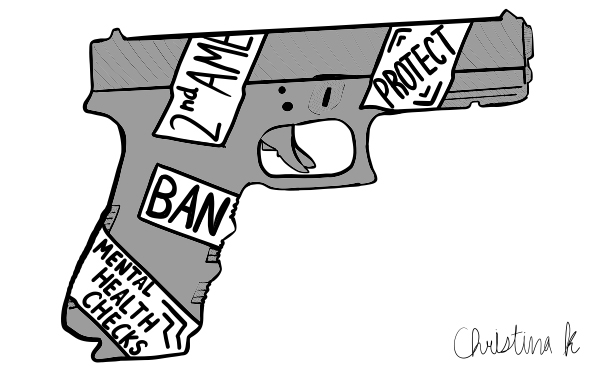
This debate is often framed as a binary choice: Do we revoke the Second Amendment, or do we protect it and focus exclusively on mental health? This polarization is our greatest enemy. While mental health focus might not be the sole solution to such a fatal problem, monitoring it more seriously could prevent violent outbursts. Improving crisis intervention such as “red flag laws,” which allow temporary firearm removal from those deemed dangerous to themselves or others, is a straightforward change that could have profound effects on safety in America.
The same goes for gun control. Many Second Amendment advocates believe that restricting gun rights would only slightly reduce the difficulty for violent criminals to obtain them. However, we at The Tower argue that any measure capable of lowering the death toll is something worth trying. Dr. Jeffery Swanson and his team analyzed decades of data from Indiana and Connecticut, finding that for every 10 to 11 gun-removal actions taken, one life was saved. No matter how small the action may seem, little changes can ripple into something larger. Any step in the right direction is a step worth taking.
The government: What they should do
We at the Tower believe that our government should focus both on ways to keep less guns on the street and evidence-based initiatives that bypass the typical Second Amendment stalemate. First and foremost, advancement on “red flag” laws along with heavy restrictions on assault weapons would not only prevent the amount of dangerous weapons on the street, but also lessen the number of dangerous hands they might fall into. Additionally, the federal government should expand funding for Community Violence Intervention (CVI) programs. These initiatives intend to mediate conflicts before they turn deadly and have been shown to reduce shootings by as much as 60 percent in dangerous areas. The government’s role in gun control should not be to simply “take away” or “do nothing,” but to facilitate a culture of risk reduction.
The individual: What you can do
While we wait for legislative shifts, change can start on the porch before it reaches the podium. The responsibility for a safer America rests on the shoulders of every citizen. Those who own firearms should consistently keep their guns secure and practice safe behavior when dealing with a weapon that has the power to take a life. Every life saved is a testament to what happens when we choose action over apathy.
For non-gun owners, promoting safety comes in many forms, such as advocating for legislation by contacting state lawmakers or exercising your freedom of assembly, as well as staying informed and aware of topics surrounding gun safety and mental health. Staying educated and educating others will help society come together in understanding about the problems and solutions of gun violence, which can lead to even greater change and save even more lives. A life is more than a statistic, and we at The Tower see this problem as more than just politics; it is universal. By uniting ourselves and our government, we can build the future we all so desperately long for.