


































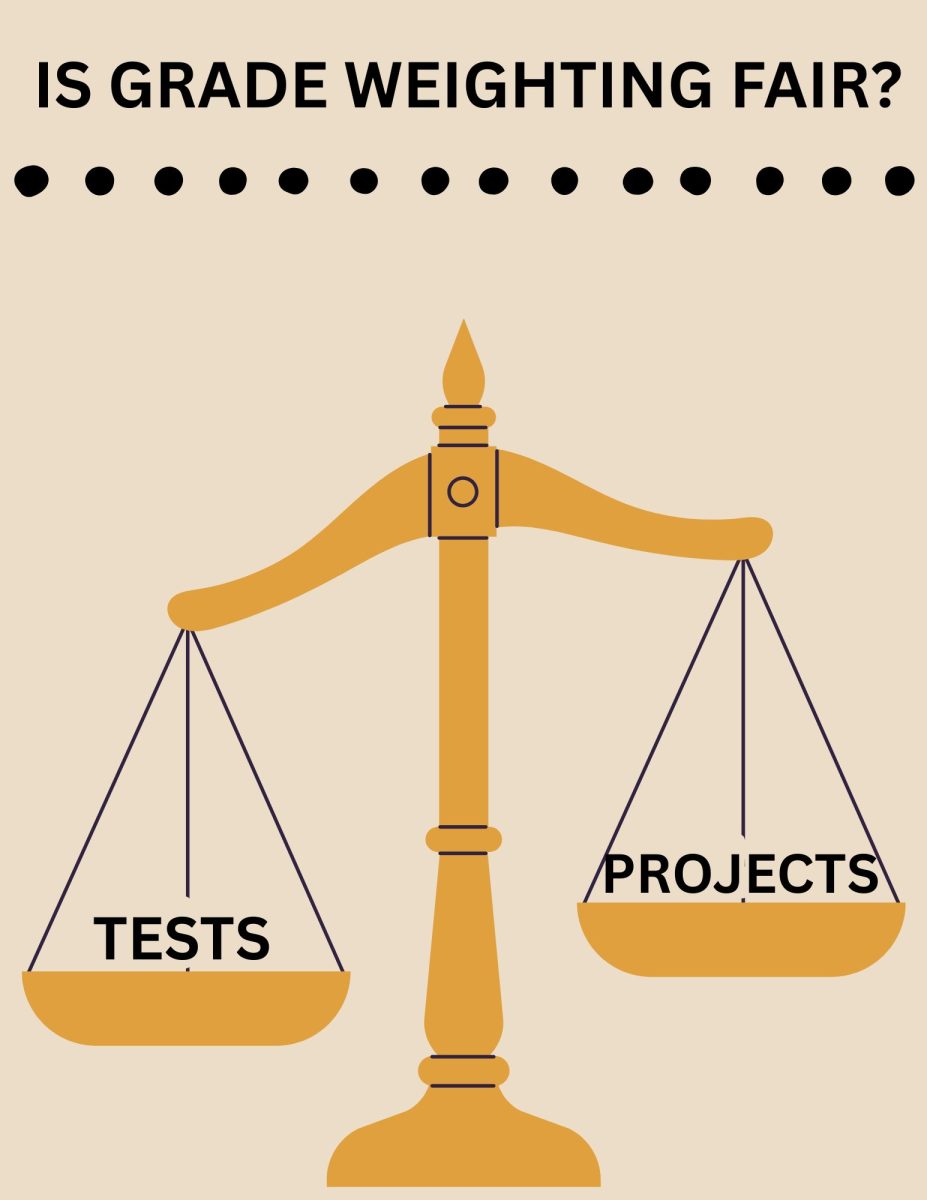
Weighted tests are a very important aspect of a high school career; they can be broken down into different parts and there are many methodologies when it comes to high school departments choosing how to weight their tests. It can be difficult to find a balance between measuring students’ learning progress versus causing testing anxiety, resulting in lower scores all around.
Lainey Weissman, a junior at the University of Michigan who also serves as a teaching assistant, explains how she believes that tests are beneficial when it comes to standardizing the individual progress of students, but how collaborative projects can also be helpful to demonstrate students’ abilities. Weissman argues that the weight of tests should also be balanced with projects, as some students may understand a concept but might not be able to perform well in a traditional test format. When tests are weighted heavily, it can cause damage to students’ grades, even though they understand the topics.
“I think it’s important to understand that everyone learns differently,” Weissman said, “Having your grade be a combination of a lot of different things is more inclusive of all students’ abilities, as some demonstrate their understanding better through projects. Making tests that are 80 percent of someone’s grade can be really destructive for high school students’ GPAs.”
The stress that is induced by tests for students can be hard, especially at the high school level. However, students need to take the stress and use it as motivation, as heavily weighted tests can actually be helpful for students who have figured out how to “study” productively. Weighted tests can be important when demonstrating the knowledge and equity of students who are willing to prepare.
Peter Palen, South history teacher and social studies department chair, explains how, although tests can provide stress for students, weighing them heavier than small, low-effort homework assignments is necessary when trying to motivate them to demonstrate their mastery of a subject. Providing students with a timeframe is also important, as it allows them to know when a test that will affect their grade is approaching, enabling them to take the necessary time to prepare.
“It’s important to have like a snapshot at a certain point in time,” Palen said, “There’s a certain finality to, you know, a test that’s weighted more heavily than homework, because it signals to students, like, here’s the time to demonstrate your knowledge on a subject.”
Many people have different opinions about how tests should be weighted, as there are advantages and disadvantages of having a test be worth most of a student’s final grade. The overall goal for administrators and teachers is to find a balance. The purpose of testing in the first place is for students to demonstrate what they know and how their learning has developed.
“The point of testing is for students to be able to show their individual progress, because most of the time, tests are always a big part of your grade, in high school and in college,” Weissman said.